Saturday, December 19, 2009

Lifestyle – Want privacy on Facebook? Here is how to get some


Sent to you by Joe via Google Reader:


via Good Read by spoonfeedin on 12/17/09


BARBARA ORTUTAY, AP Technology Writer Barbara Ortutay, Ap Technology Writer Thu Dec 17, 3:54 pm ET
NEW YORK – Over the past week, Facebook has been nudging its users — first gently, then firmly — to review and update their privacy settings.

You may have procrastinated by hitting "skip for now," but Facebook eventually took away that button and forced you to update your settings before continuing to use the site.

After finally accepting Facebook's recommendations or tweaking the privacy settings yourself, though, you might have made more information about you public than what you had intended.

At the same time, Facebook has given users many granular controls over their privacy, more than what's available on other major social networks.

So if you want to stay out of people's view, but still want to be on Facebook, here are some things to look out for as you take another look at your settings.

1. Some of your information is viewable by everyone.

Everyone can see your name, your profile photo and the names of work and school networks you're part of. Ditto for pages you are a fan of. If you are worried about a potential employer finding out about a quirky fetish or unorthodox political leaning, avoid becoming a Facebook fan of such groups. You can't tell Facebook you don't want those publicly listed. Your gender and current city are also available, if you choose to specify them. You can uncheck "Show my sex in my profile" when you edit your profile if you don't want it listed, and you can leave "Current City" blank.

2. Your list of friends may also be public.

Facebook also considers your friends list publicly available information. Privacy advocates worry that much can be gleaned from a person's list of friends — even sexual orientation, according to one MIT study. But there is a way to hide the list. Go to your profile page and click on the little blue pencil icon on the top right of your box of friends. Uncheck "Show Friend List to everyone." Either way, those you are already friends with can always see your full list.

3. You can hide yourself from Web searches.

There is a section for "Search" under Facebook's privacy settings page, which is accessible from the top right corner of the Web site under "Settings." If you click the "Allow" box next to "Public Search Results," the information that Facebook deems publicly available (such as photo, fan pages and list of friends), along with anything else you have made available to everyone, will show up when someone looks up your name on a search engine such as Google. The stuff you've limited access to in your profile will not show up.

This is useful if you want people you've lost touch with, or potential work contacts, to be able to find your Facebook page. If you'd rather not be found, uncheck this box.

A second setting, controlling searches within Facebook, lets you refine who can find you once that person has logged on. Limit searches to friends only if you think you have all the friends you need and don't want anyone to find you when they type in your name to Facebook.

4. Beware of third-party applications.

Quizzes and games are fun, but each time you take one, you first authorize it to access your profile information, even if you have made that available only to your friends. You're also letting the app access some information on your friends.

Under "Application Settings," Facebook lists all the apps you have opened your profile up to. If you no longer want to authorize access to "Which Golden Girl Are You?" you can always remove it by clicking on the "X" next to its name. Apps you use regularly, such as Facebook for Android if you update your status from your mobile phone, should stay.

Next, by clicking on "Applications and Websites" on the privacy settings page, you can edit whether your friends can share your birthday, photos and other specific information. Remember that applications can access your "publicly available information" no matter what.

The security firm Sophos recommends users set their privacy settings for two of Facebook's own popular applications, notes and photos, to friends only.

5. Go over your list of friends.

The average Facebook user has 130 friends. But many people interact with a much smaller group when commenting on status updates, photos and links. So it doesn't hurt to occasionally review your list of your friends to get an idea of just who can view your status posts, vacation photos and funny links you've shared over the years. Don't feel obligated to add anyone as a friend, even if that person adds you first. For professional acquaintance you don't want to snub, send them to a LinkedIn profile you can set up. Some workplaces and schools have rules about Facebook interactions between bosses and employees or students and teachers.

6. Create custom friends groups.

If you have friended a lot of people, sort them. Think of the groups you interact with in real life — co-workers, college buddies, girlfriends, grandma and grandpa — and organize your Facebook friends in these groups, too. Go to "All Friends" under the "Friends" button up top, click on "Create New List" and fire away. Then decide what aspects of your profile, and which status posts and photos, these people will have access to. Or, simply create a "limited" list for acquaintances or distant relatives and limit their access.

7. Customize your status posts.

Type "I'm hungry" into your status update box. Click on the little lock icon. You'll see a range of privacy controls pop up, letting you either allow or limit access to the post. If you want, you can even hide it from everyone by clicking "Only Me" under the custom settings. Click on "Save Setting." Repeat with each post, or create a default setting for most updates and increase or decrease privacy as you see fit.

8. Let your friends know you have boundaries — in person.

Many of us have woken up on a Sunday morning to find that an overzealous friend has posted dozens of photos from that wild party we barely remembered — the good, the bad and the hideous. Chances are, they didn't do this to embarrass you, though if they did you have bigger problems. Rather, they probably don't know that you don't want these photos posted. Sure, tweak your photo privacy settings on Facebook. But if someone starts snapping pictures of you at a party, ask them to check with you before posting it anywhere.

9. Never assume complete privacy.

Even for the most tech-savvy person, unflattering photos, incriminating text messages or angry status posts about work have a way of worming their way out in the open. Just saying.

Tagged: AP


Things you can do from here:


Apple vs. Sony: A Tale of Two Marketing Campaigns


Sent to you by Joe via Google Reader:


via The Corner Office by Steve Tobak on 12/11/09

There's no business discipline that inspires more polarized views or confusion than marketing. That's because great marketing is rare, bad marketing is common, and it's sometimes hard to tell the difference. When you bet the company on a marketing campaign, you're taking a huge risk.


Things you can do from here:


China's Currency and Reserves--Posner

Read the Becker article before reading this..


Sent to you by Joe via Google Reader:


via The Becker-Posner Blog by Richard Posner on 11/23/09

Becker's analysis is impressive, but I hesitate to state with confidence that China would be better off to revalue its currency. As Becker points out, China has pegged its currency to the dollar at a rate of exchange that greatly undervalues its currency relative to ours. As a result China sells goods to U.S. producers and consumers at very low dollar prices and buys goods from U.S. producers at very high prices. In consequence it exports a lot to the U.S. (and to other countries as well, for its currency is undervalued relative to other currencies besides just the dollar, notably the euro) and imports little. Since it receives more dollars than it pays, it has accumulated huge dollar reserves--accumulated them rather than giving them to its people. It has more than $2 trillion in foreign reserves, mostly U.S. dollars. The dollar has been falling lately, and the value of China's dollar reserves with it.

Could China have sensible reasons for such an odd, old-fashioned policy ("mercantilism"--the maximization of a nation's cash or cash-equivalent reserves--famously attacked by Adam Smith more than two hundred years ago)? It could. The immense exports that China's skewed exchange policy has fostered provide employment for a large number of Chinese. Their wages are low, but at least they have jobs. Of course they might have jobs if the dollar were cheaper relative to Chinese currency. China would import more and export less. It would manufacture less, because many workers would be required for the expanded system of domestic distribution that would be necessary if domestic consumption (both of Chinese manufactures diverted from export to internal markets and of imported goods). It would manufacture a different mixture of goods, because of competition from imported goods, but above all it would need a much more elaborate system of wholesale and retail distribution, and perhaps a different commercial culture. The transition to a modern consumer society with its credit cards and product warranties and malls and the rest would be difficult. In the interim there might be widespread unemployment; shifting employees from manufacturing to distribution, or from one type of manufacturing to another, doesn't happen overnight. And China doesn't have the kind of social safety net that we do, to catch the unemployed before they reach the bottom. Because of the limitations of domestic consumption, Chinese are great savers, and this relieves the pressure the government would otherwise feel to provide social services. That provision might strain the government's administrative abilities.

China has a long history of political instability, and there is tension between its dictatorial communist government and its largely free-enterprise economy. It is naturally reluctant to take chances on changing its economy from one of producing manufactured goods for export to one of manufacture and distribution primarily for domestic consumption.

And there is value to China in those trillions in foreign reserves that it has accumulated. They magnify its global power. China is our major creditor. It finances our deficit. Like any dependent debtor, we must be very careful not to offend our major creditor. It is true that our relation with China is one of bilateral monopoly: if we devalue the dollar (which we may be doing) in order to lighten our debt burden, we hurt China; but if China in retaliation stops buying our Treasury bonds, we are badly hurt.

For all these reasons, while China is likely to abandon mercantilism in the long run, it probably is sensible for it to do so gradually.

Would we benefit from China's abandoning mercantilism? As Becker points out, our consumers benefit from the artificially low prices at which Chinese goods are sold in this country. At the same time, our dependence on China's financing our public debt weakens our ability to influence Chinese policy on issues of urgent concern to us, such as the threat of nuclear proliferation posed by North Korea, Iran, and Pakistan, and the need to take effective steps to limit global warming.

Then too it seems that the only way in which we can buy those cheap goods from China is to borrow from China. We buy more from China than we sell to it and so China accumulates dollars to bridge the gap, dollars that it then lends to the U.S. Treasury. The effect is to reduce pressure on our government to pay down our immense and growing public debt either by raising taxes or by cutting spending. We cannot continue along the path of ever-growing debt unless our economy grows very rapidly, which is not assured. So I am not sure that I agree with Becker that China's policy is good for us and bad for it. The reverse may be truer.


Things you can do from here:


Should China Allow its Currency to Appreciate? Becker


Sent to you by Joe via Google Reader:


via The Becker-Posner Blog by Gary Becker on 11/23/09


By all accounts, President Obama's visit to China last week was pretty much a failure on all the major issues, which include China's contributions to climate change, nuclear weapons, and various aspects of the world economy. I will concentrate my discussion on two of the most important and closely related economic issues: the valuation of the Chinese currency, the renminbi, and the huge assets accumulated by China that are mainly held in the form of US Treasury bills and other US government assets.

The Chinese central bank held the value of the renminbi fixed relative to the US dollar at a little over 8 renminbi per dollar during the 1990s, and until 2005. It then allowed the renminbi to appreciate gradually to less than 7 per dollar until 2008, when it again fixed the rate of exchange between these currencies at about 6.9 renminbi per dollar. This exchange rate is considerably above a free market rate that would be determined in a regime of flexible exchange rates. So there is no doubt that China is intentionally holding the value of its currency below the rate that would equate supply and demand.

The dollar has depreciated substantially relative to other currencies since May of 2009. Since the renminbi is tied again to the dollar, the renminbi has depreciated by the same amounts, including 16% against the euro, 34 % against the Australian dollar, 25% against the Korean won, and 10 % against the Japanese yen. This substantially depreciation of the Chinese currency has made many other countries angry at China's policy of locking it to the US dollar.

President Obama apparently complained to Hu Jintao, President of the People's Republic of China, about the low value of the renminbi, and urged China to allow it to appreciate substantially. The US and other countries worry that the undervaluation of the Chinese currencyi increases the demand for Chinese exports, and reduces China's demand for imports from countries like the US because China keeps the dollar and the currencies of other countries artificially expensive relative to their currency. America and other countries hope that greater demand from China for their exports resulting from a higher value of the renminbi will help these countries resume sizable economic growth as they recover from this severe recession. They especially want to help reduce the high levels of unemployment found in many of these nations.

Indeed, in good part due to the low value of its currency, China has run substantial surpluses on its current trade account as it imports fewer goods and services than it exports. The result is that China has accumulated enormous reserves of assets in foreign currencies, especially in the form of US government assets denominated in dollars. As of September of this year, China had the incredible sum of over 2 trillion dollars in foreign currency reserves, such as US Treasury bills. This is by far the highest reserve in the world, and it amounts to the enormous ratio of more than one quarter of China's GDP of about $8 trillion (purchasing power parity adjusted).

I am dubious about the wisdom of both America's complaints about China's currency policy and of China's responses. On the whole, I believe that most Americans benefit rather than are hurt by China's long standing policy of keeping the renminbi at an artificially low exchange value. For that policy makes the various goods imported from China, such as clothing, furniture, and small electronic devices, much cheaper than they would be if China allowed its currency to appreciate substantially in value. The main beneficiaries of this policy are the poor and lower middle class Americans and those elsewhere who buy Chinese made goods at remarkably cheap prices in stores like Wal-Mart's that cater to families who are cost conscious.

To be sure, US companies that would like to export more to China are hurt by the maintenance of the Chinese currency at an artificially low value relative to the dollar. As a result, employment by these companies is lower than it would be, so that this may contribute a little to the high rate of US unemployment. But I believe the benefits to American consumers far outweigh any loses in jobs, particularly as the US economy continues its recovery, and unemployment rates come back to more normal levels.

Since the opposite effects hold for China, I cannot justify their policies from the viewpoint of their interests. Their consumers and importers are hurt because the cost of foreign goods to them is kept artificially high. Their exporters gain, but as in the US, that gain is likely to be considerably smaller than the negative effects on the wellbeing of the average Chinese family.

I reach similar conclusions about China's accumulation of their excessive reserves. The US has little to complain if China wants to hold such high levels of low interest-bearing US government assets in exchange for selling goods cheaply to the US and other countries. China's willingness to save so much reduces the need for Americans and others to save more, but is not differences in savings rates also part of the international specialization that global markets encourage? To be sure, why China is willing to do this is difficult to understand since they are giving away goods made with hard work and capital for paper assets that carry little returns.

One common answer is that China hopes to increase its influence over economic and geo-political policies by holding so many foreign assets. Yet it seems to me just the opposite is true, that China's huge levels of foreign assets puts China more at the mercy of US and other policies than visa versa. China can threaten to sell large quantities of its US Treasury bills and other US assets, but what will they buy instead? Presumably, they would buy EU or Japanese government bills and bonds. That will put a little upward pressure on interest rates on US governments, but to a considerable extent, the main effect in our integrated world capital market is that sellers to China of euro and yen denominated assets would then hold the US Treasuries sold by China.

On the other hand, the US can threaten to inflate away some of the real value of its dollar denominated assets-not an empty threat because of the large US government fiscal deficits, and the sizable growth in US bank excess reserves. Inflation would lower the exchange value of the dollar, and also of the renminbi, as long as China keeps it tied to the dollar. That would further increase the current account surpluses of China, and thereby induce China to hold more US and other foreign assets, not a very attractive scenario to China.

So my conclusion is that the US in its own interest should not be urging China to appreciate its currency- countries like India have a much greater potential gain from such an appreciation. On the other hand, I see very little sense at this stage of China's development in maintaining a very low value of its currency, and accumulating large quantities of reserves. Paradoxically, President Obama and President Jintao should each have been arguing the others positions on these economic issues.


Things you can do from here:


Friday, December 18, 2009

Aftermath of Iceland Economic Crisis


Sent to you by Joe via Google Reader:


via Economics Essays by Tejvan Pettinger on 12/9/09

What happens when your financial sector and economy collapses?Iceland will provide an interesting case study for future economists

To recap:
  • Iceland's banking sector expanded rapidly as they lent money to financial institutions around the world.
  • The foreign exposure of Icelandic banks were enormous, their loans and other assets totalled more than 10 times the country's GDP
  • In 2007/08, the subprime mortgage crisis led to a spate of loan defaults in the US, but, this spread around the world. Icelandic banks had exposure to these toxic loans and soon there losses mounted. Given extent of banking loans, Icelandic banks suddenly looked very vulnerable.
  • Despite government attempts the banks went bankrupt and they were forced to borrow $10bn from the IMF.
The main implications of this Financial Crisis are:
  • Rapid depreciation in the Currency.
  • This reduces living standards and increases price of imports
  • McDonalds recently left Iceland because a Big Mac would be too expensive after importing raw materials
  • Unemployment has increased from 1% to 10%
  • GDP has fallen 7%
  • Inflation has increased to 11%
Yet, despite these dire economic statistics it is not quite the end of the world. The rise in unemployment could have been worse and there is a prospect of returning to 0% growth in 2010.

The initial anger of Icelanders at their bankers, their government, the British government, foreign bankers e.t.c has somewhat melted away and people have started to view their lifestyle in a new light. I have a few friends who run a cafe in Reykavik, they tell me the initial fears of the crisis proved to be less dangerous than they first feared. Business has held up reasonably well, what they really notice is how expensive foreign travel has become. They also suggest, the fashion for expensive luxuries and SUVs are fading are being replaces by a more frugal, simplistic, "back to our Viking routes" kind of lifestyle. It's no longer so fashionable to pose in Dolce & Gabanna imports, it is more fashionable to be making homemade hair dye, from an old Viking recipe. (See also: Frugality and the economy, we looked at how frugality was becoming popular in US)

Yet, the economy remains vulnerable. The collapse of the financial sector means they are still reliant on fishing for over 40% of export revenues. This makes the economy vulnerable to depletion of stocks or fluctuations in the price of fish. There is a need to diversify and develop the economy, but, not the diversification of buying toxic subprime mortgage debts the Icelandic banks tried to their cost.... (By, the way, in 2009, the Icelandic banks were awarded the reverse IGnoble Nobel Prize for economics by Harvard University. That is pretty impressive since one ig prize was awarded for the bra which could easily be converted into two gas masks.... Ignoble Prizes list)

Many now see the EU has offering salvation for the economy. But, joining the EURO does not solve your underyling problem as Greece, Spain and Ireland are learning to their cost.

Related


Things you can do from here:


Falling Dollar


Sent to you by Joe via Google Reader:


via Economics Essays by Tejvan Pettinger on 11/26/09

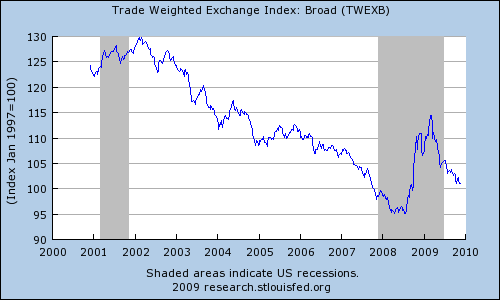
For the past decade, the US Dollar has been weak, falling against a basket of currencies. A falling dollar has many implications for both the US and world economy. It is not necessarily a bad thing. A falling dollar, in many ways, is necessary to readjust the global and US economy.

Reasons for Falling Dollar

Persistent US Current account deficit.

Due to a decline in competitiveness and a low domestic saving ratio, the US has been running a current account deficit. Basically, they are buying more imports of goods and services than they export. A current account deficit puts downward pressure on the dollar, especially as capital flows to finance the deficit dry up. Even after a recession and a rise in domestic spending, the US current account deficit remains persistently high (at $500bn). Some economists say a current account deficit is nothing to worry about and reflects the US ability to attract capital. But, there are signs that overseas investors are becoming less willing to buy US assets.

Long Term Changes in Structure of Global Economy.

In the post war period, the US economy was the world's largest and dominant economy. This meant the US dollar was the global reserve currency and used to denominate oil and gold prices. With the rise of China and India, and the Euro, the US economy is becoming relatively smaller. Thus, it is slowly and gradually losing its status as the world's reserve currency, which is pushing down the dollar.

Worries over Debt and Inflation.

The US is certainly not alone in having a rise in Public debt. However, the recession and financial bailout is pushing US public sector debt towards 100% of GDP. Since the Federal Reserve is also pursuing quantitative easing (creation of dollar) investors are becoming more nervous about dollar assets. They fear, a prolonged policy of increasing money supply could lead to inflation and devalue the dollar.

Related


Things you can do from here:


US Economy in 2010


Sent to you by Joe via Google Reader:


via Economics Essays by Tejvan Pettinger on 12/7/09

After the deepest recession since the Great Depression, there is understandably considerable relief at the first signs of growth in the US. Recent job figures also suggest the economy has turned. However, some commentators worry that these first greenshoots could lead to a complacent feeling and that the US economy still faces many weakness in 2010.

Economic Growth and Spare Capacity

growth

This graphs shows the extent of the decline in economic output. The recession of 2009 easily dwarves the modest decline of 2001. The red line indicates the potential rate of economic growth. This shows how much spare capacity will exist in the US economy in 2010, this will make it difficult to tackle the unemployment problem.

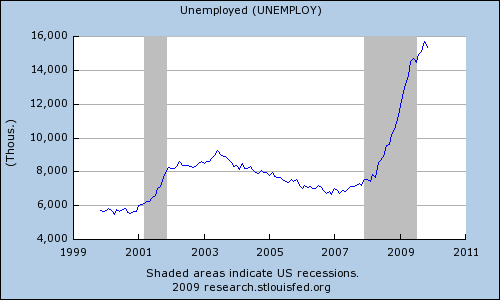
Unemployment in US

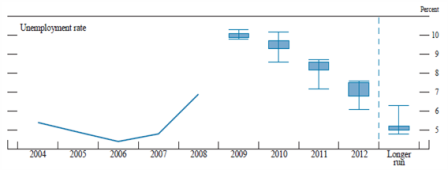
The sharp rise in unemployment is perhaps the biggest problem facing the US economy. Like the UK, the rise in unemployment has been muted by a fall in working hours and increase in temporary employment. The bad news is that the forecast for unemployment in 2010 and 2011 is for a continued period of high unemployment.

Forecast for US Unemployment

Unemployment rates in 2010 and 2011 - source: P.Krugman

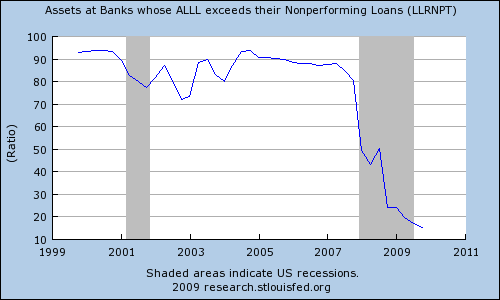
The Problem with US Banking Sector

As we mentioned in a recent post - Worries over future home foreclosures - the US banking sector still faces more potential losses from home repossessions. This graph shows how much banks have been affected by the housing market crash and credit crunch. It will take a long time for banks to recover balance sheets and ability to lend like before the crash.

Assets of US Banks

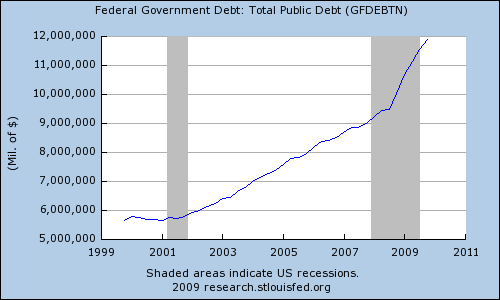
Budget Deficit

The US budget deficit continues its remorseless rise. Now over $12 trillion, it continues to rise as a % of GDP. It has also become an important political issue. With more voters apparantely concerned about the deficit than unemployment. The debt is a long term problem, but, efforts to reduce it in the short term could dampen the economic recovery and push the economy back into recession.


The Dollar in 2010

Many people might be a little surprise at how much the dollar rallied from the summer of 2008. But, this year, the dollar has regained its downward momentum, and it is hard to see a reversal in the dollar fortunes given state of economy.

Inflation and Interest Rates


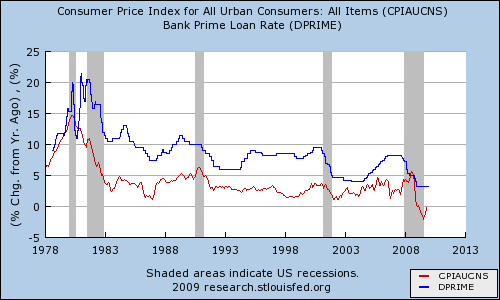
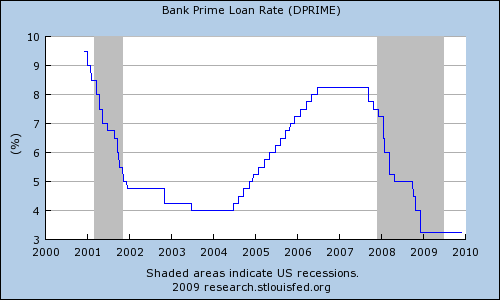
There are some who apparently worry about inflation prospects in the US. But, I still feel the US has more to fear from inflation than deflation. Inflation is likely to remain low during 2010 because of the spare capacity and lack of wage pressures. As a consequence, interest rates are likely to remain low throughout 2010.


Related

Image Sources: St Louis Fed


Things you can do from here: